Clonmany heritage
event
10.08.26
CLONMANY Genealogy &
Heritage Group to host a Heritage Event on Saturday 15th
August as part of National Heritage Week 2026.
‘Memories of Place’ is a unique and engaging event
offering a guided heritage walk at 10am, an exhibition
from 10am – 4pm, and an illustrated talk at 3pm. You
will be able to learn about the history of Clonmany
during the Guided Walk and then find out about the
skills and crafts of the local people and peruse the
many artefacts collected for the exhibition. The
illustrated talk will explore the many traditions,
customs, beliefs and folklore associated with wakes and
funerals in Inishowen in the past.
Although now one of Inishowen's best-known villages,
Clonmany is believed to be among the youngest villages
in the peninsula. In the early 1800s, only a handful of
buildings stood where the village is today. These
included a constabulary barracks, a revenue barracks, an
infantry barracks and St. Mary's Catholic Church, which
was built in 1795.
At that time, the area's main centre was Straid, home to
a church, school, forge, post office, dispensary, corn
mills and three notable residences—Dresden House,
Dunally House and Glen House. |
 |
|
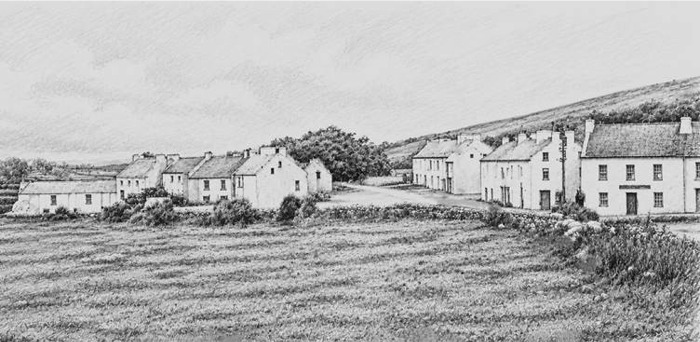
An artist’s impression of
Clonmany in the early 1900s |
The village began to take
shape with the construction of the National School at
Gaddyduff in 1836 and the Market House in 1858. Markets
and fairs held in Market Square attracted traders and
visitors, helping Clonmany flourish as shops, homes,
public houses, a hotel and other businesses were
established around what became known locally as The
Cross.
Throughout the twentieth century, the village continued
to grow. St. Mary's Church was renovated, a community
hall was built, and Clonmany even had its own cinema.
The arrival of the railway in 1901 greatly improved
access, bringing increased trade and tourism to the
area.
The First World War left a lasting mark on Clonmany.
During the conflict, the British Army established
Glenfield Training Camp in Straid, close to Glen House.
The camp had a significant impact on village life, with
soldiers becoming a familiar presence and providing an
important boost to the local economy.
The Clonmany Genealogy & Heritage Group has undertaken
extensive research into this period of local history. In
2018, a commemorative ceremony was organised in the Old
Church, Straid, honouring a young teenage soldier from
Oxford who is buried there. The Group is currently
carrying out further research into the story of a young
Scottish soldier who tragically lost his life locally,
in 1917, while rescuing a fellow soldier from drowning. |
 |
|
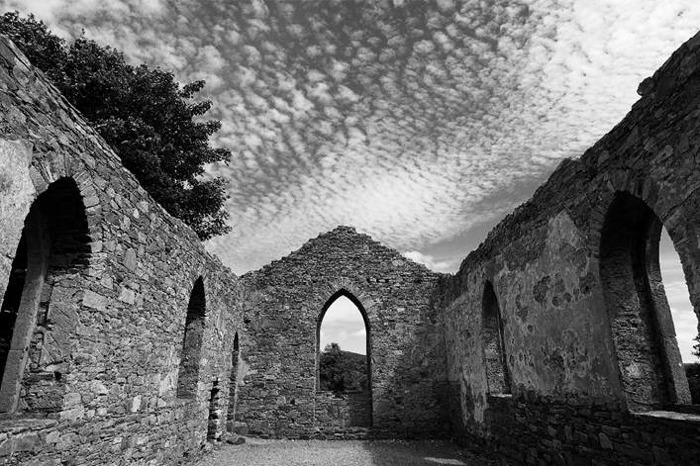
The Old Church in Straid |
Perhaps the most
distinguished military figure with Clonmany connections
was Major General Sir Harry Neville Thompson. Born in
Clonmany in 1861, he was the son of the Reverend Mungo
Neville Thompson, the last Church of Ireland Rector of
Clonmany. During an exceptional military career, Sir
Harry served in Hong Kong, Sudan, South Africa and
India. He served as a medic in both the Boer War and the
First World War, receiving numerous international
honours. He became Surgeon General of the British Army
and previously served as personal physician to the
Viceroy of India. It is possible he is the only person
born in Clonmany to have received a knighthood. He died
in 1925.
Following the guided heritage walk, visitors are invited
to enjoy refreshments in the Market House Café before
exploring the exhibition upstairs. The display features
an impressive collection of artefacts, photographs and
memorabilia that illustrate Clonmany's rich heritage,
alongside examples of traditional crafts and skills once
central to everyday life in the area. A local historian
will deliver a short talk upstairs in the Market House
at 12:30.
Beginning at 3pm in the upstairs hall of the Market
House, this illustrated presentation explores one of
Ireland's most enduring traditions. Historically, wakes
and funerals throughout Inishowen were much more than
ceremonies of farewell. They were important community
gatherings where neighbours supported bereaved families
by sharing food, lending household items, keeping vigil
through the night and ensuring that no family faced
grief alone.
The Irish wake has its origins in ancient Celtic and
Anglo-Saxon traditions. The word wake derives from Old
English, meaning 'to watch' or 'to guard.' In earlier
times, the vigil served to protect the deceased from
animals and evil spirits while also confirming death
before the development of modern medicine. Over
generations, these practical and spiritual traditions
evolved into gatherings where stories, music, food and
shared memories celebrated the life of the deceased.
The presentation will examine many of the customs,
beliefs and superstitions associated with Irish wakes
and funerals, including funeral etiquette, encounters
with funeral processions, the significance of crossroads
and water crossings, the covering of mirrors, stopped
clocks, candles, signs from nature, the legend of the
banshee, and many other fascinating traditions that
formed an important part of life in Inishowen.
Visitors will also be able to enjoy musical
entertainment during the exhibition, provided by local
performers. Everyone is invited to come along, admission
is free. Refreshments are available in the Market House
Café and toilet facilities are provided on site. |
|